
Hosted architecture: push to publish
A push to the docs repository becomes live, filtered docs through four parts: a web service, a build worker, Postgres and a blob store.
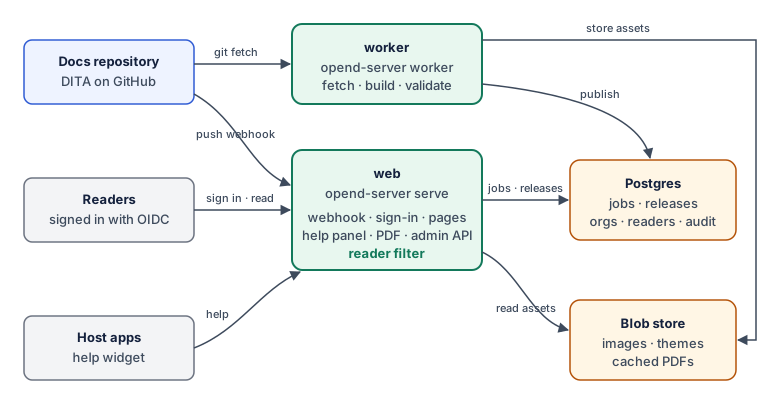
The parts
- web (
opend-server serve) - Receives GitHub webhooks, signs readers in, serves pages, the help panel, PDFs and the admin API. Stateless: run as many replicas as you like.
- worker (
opend-server worker) - Claims build jobs, fetches the exact pushed commit, builds and validates it, uploads images and the theme, indexes it for search, and publishes. Several workers can share the queue.
- Postgres
- The job queue, release snapshots and their search indexes, which release is live for each release line, organizations, entitlements, readers, webhook deliveries and the audit log.
- Blob store
- Images and themes for each commit, and cached PDFs. A local folder when web and worker share a disk, otherwise any S3-compatible bucket.
An optional fifth part, the web editor (opend-server editor serve), runs on its
own host. It lets authors who do not use Git save to their own branch and publish through a pull
request, committing through the GitHub App, so content still reaches readers only by a push. See Run the web editor.
One image runs every role: serve, worker,
migrate, seed, reconcile,
reindex and editor. It is configured only with environment variables;
see the environment variable reference.
From push to live
- GitHub sends a push webhook to
/webhooks/github. The web service checks its signature, ignores deliveries it has already seen, and queues a build if the pushed branch or tag is one of the repository's release refs. It answers 202 only once the job is safely stored. - A worker claims the job (it wakes on a notification, and also polls every five seconds), fetches
that one commit, and runs the same build and validation as
opend validate. - If validation finds an error, the build fails: the diagnostics are stored with the job, the commit
gets a failed
opend/buildstatus, and the previous release stays live. - Otherwise the worker stores the images and theme, saves the release snapshot, and makes it live for its release line, unless a newer build already went live.
- Infrastructure problems, such as a failed fetch, are retried with growing delays, up to five attempts.
Serving readers
- A signed-in reader's organization gives their products, features and version. The version's major number picks the live release; the reader filter does the rest.
- Filtered views and pages are cached per entitlement set, not per user, and cleared at once when an admin changes entitlements or a new release goes live.
- Pages are sent with
Cache-Control: private, no-storeand a strict Content Security Policy, and run no scripts. - The site serves one docs repository. If several are registered,
OPEND_SITE_REPOsays which.
Multi-tenancy, with many sites in one deployment, is planned for a later release.